What should be true
Source of truth. Who was hired, who owns which device, and who has left — the authoritative record from your HRIS, ITSM, or asset inventory.
HRISServiceNowAsset InventoryCSV
MekaOps sits on top of the data you already collect and reconciles it. No agents, no rip-and-replace — just the truth about every identity and device, from onboarding through offboarding and the endpoints you never knew about.
Source of truth. Who was hired, who owns which device, and who has left — the authoritative record from your HRIS, ITSM, or asset inventory.
MDM. The devices your management platform actually has on record — and the owner assigned to each one.
Device trust. Who is signing in, which endpoints are live in the wild, and where your security agents are actually running.
Assign each connected platform a role — source of truth, MDM, or device trust. Read-only by default; no agents to deploy.
One engine correlates the signals per person and per device and evaluates them against your role configuration — at onboarding, ownership, offboarding, and discovery.
Each identity and device gets an assurance result. Disagreements become clear, categorized findings — not another raw export to diff by hand.
Route findings to the right owner — push a Jira or ServiceNow ticket, correct the record at the source — and the next scan confirms the case returns to an assured state.
Try the full workflow on a live sample fleet atdemo.mekaops.com.
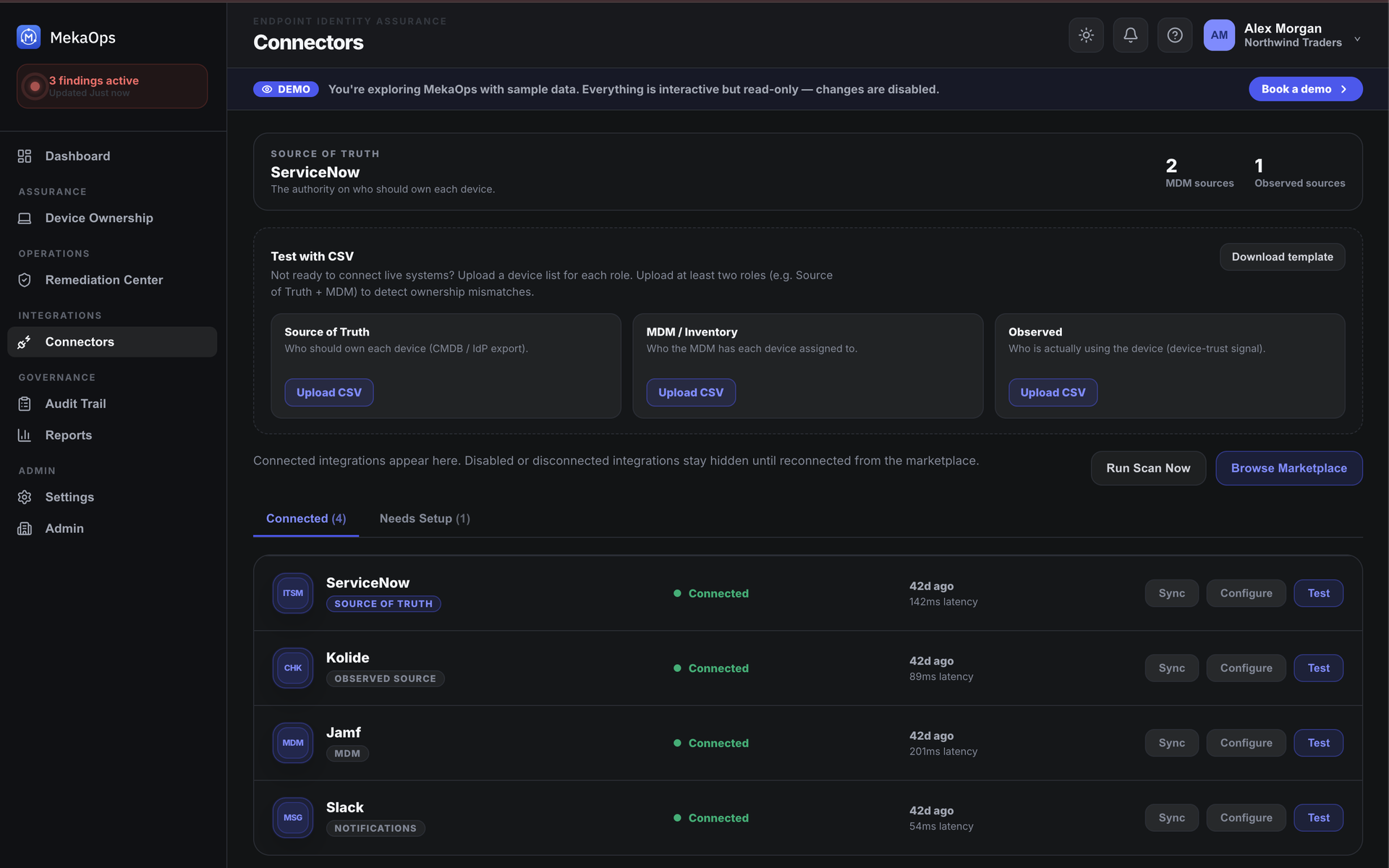
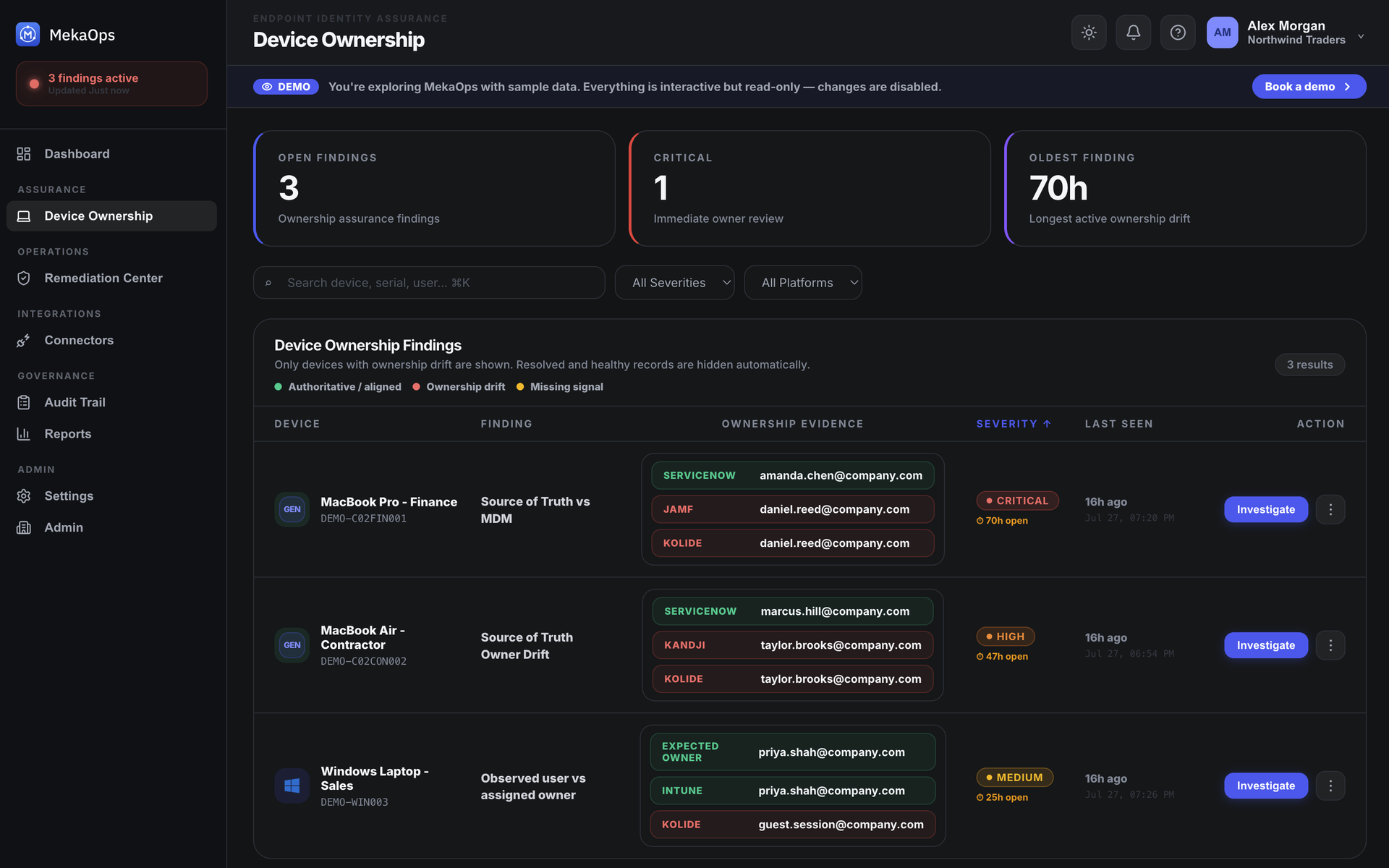
MekaOps is live and in active use with early-access design partners. The reconciliation engine and four lifecycle modules — device ownership, onboarding, offboarding, and discovery — all ship today, along with SSO, SCIM provisioning, and role-based access. We're keeping the program small while we onboard partners, so join early access to get set up.
Four live modules on one reconciliation engine. Onboarding confirms new hires land with the right device; device ownership reconciles who should own each device against who's assigned and who's observed; offboarding proves departing workers are fully cleared; discovery surfaces endpoints that never made it into your MDM. Each finding runs through a remediation loop that re-verifies the fix. Access (mover) assurance is the natural next step, and we build it out as design partners need it.
It's built for them. Single sign-on via OIDC (Okta, Entra ID, or Google), automated SCIM provisioning, role-based access control, a categorized audit trail, live presence, and SOC 2 / HIPAA / HITRUST compliance reporting are all in the product today — so MekaOps fits your existing identity and governance requirements rather than adding another silo.
No. MekaOps reconciles data you already collect from your source-of-truth systems, MDM, and device-trust signals. It's read-only by default, so you can evaluate ownership assurance without adding another endpoint agent. If you later use remediation to correct a record, that write-back is opt-in and scoped to the systems you authorize.
MekaOps is stack-agnostic. You assign each connected system a role — source of truth (e.g. an HRIS or ServiceNow), MDM (e.g. Jamf, Intune, Kandji, Workspace ONE), or device trust (e.g. Okta, Kolide) — rather than being locked to one vendor's model.
An MDM only knows what it was told. MekaOps compares the MDM against your authoritative owner and the user actually observed on the device — the disagreements between systems are exactly what a single platform can't see on its own.
Join the early-access program. We'll talk through your environment, the systems you'd assign to each role, and the lifecycle gaps you're seeing today — at onboarding, in steady state, at offboarding, or with unmanaged devices.
We'll map your systems to each role and reconcile your real data together — or walk the live demo first.